
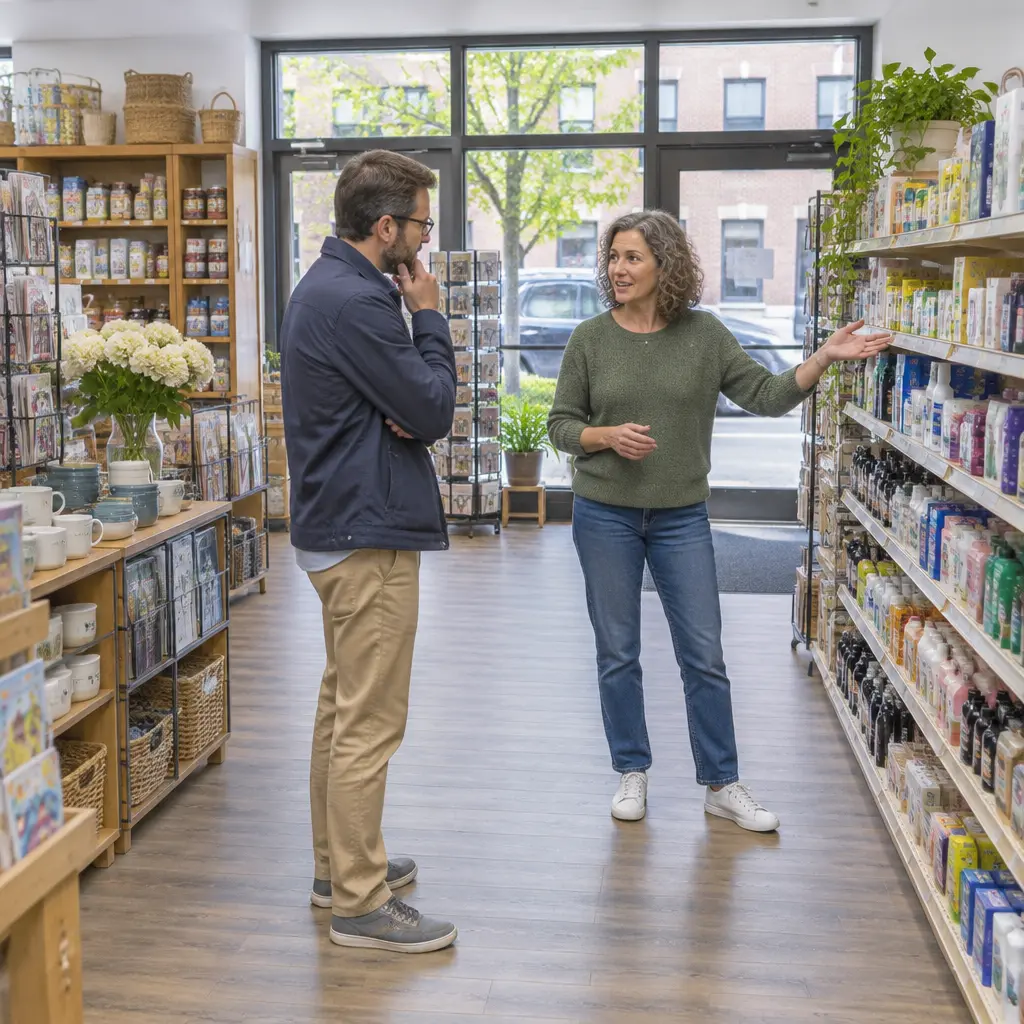
Word of mouth is the sharing of opinions and recommendations between people; in local shops, it can turn trusted customer experiences into advice that helps neighbors decide where to spend. Its influence matters because shoppers often rely on recommendations from people they know, while independent retailers compete through personal service, community ties, and reputation. This article explains how word of mouth builds customer trust, what drives recommendations, how local businesses can encourage them responsibly, and how to assess results using established research and practical examples.
Word of Mouth Builds Customer Trust in Local Shops
Word of mouth (WOM) is interpersonal communication about a product, service, or organization. Marketing researchers Robert East, Kathy Hammond, and Malcolm Wright describe it as communication between consumers about their experiences with products or services. For a local shop, WOM includes a neighbor’s recommendation, a customer review, a community-group discussion, or a referral shared in person.
Customer trust is the willingness to rely on a business based on expectations that it will act competently, honestly, and fairly. WOM can strengthen that trust because recommendations come from sources customers may regard as independent of the shop’s advertising. Nielsen’s 2021 Trust in Advertising study reported that 88% of respondents across 56 countries trusted recommendations from people they know more than any other measured advertising format. That finding indicates the broad relevance of personal recommendations, though it does not mean every recommendation leads to a purchase.
Local-shop WOM takes several forms: face-to-face referrals, online ratings and reviews, social-media conversations, and community or professional recommendations. These forms differ in reach and permanence, but each can make a business’s reputation more visible. Trust is most durable when the recommendation matches the customer’s actual experience.
Customer Trust Shapes Word of Mouth in Local Shops
Trust shapes whether customers recommend a shop, and WOM shapes whether prospective customers consider trusting it. This relationship is reciprocal rather than automatic: a glowing review may encourage a first visit, while reliable service, transparent policies, and fair problem-solving determine whether the customer returns or recommends the business.
Personal recommendations and referral trust
A personal recommendation is advice shared directly by someone whose judgment the listener values. It may reduce uncertainty about quality, price, or service because the listener can ask follow-up questions and understand the recommender’s preferences. A referral is a related but more specific form of WOM: an existing customer directs someone to a shop, sometimes using a referral code or offer. For local retailers, genuine referrals often arise from memorable service, useful expertise, or dependable products—not simply from asking customers to promote the business.
Online reviews and reputation signals
Online reviews are public customer accounts that help prospective shoppers assess a business before visiting. They can communicate details that a shop’s own marketing may not, such as how staff handle returns or whether opening hours are reliable. BrightLocal’s 2024 Local Consumer Review Survey found that 75% of U.S. consumers used online reviews “always” or “regularly” to research local businesses. Reviews therefore function as a visible form of digital WOM, but their credibility depends on specificity, recency, and signs of authentic customer experience.
Ratings should be read alongside written feedback and the business’s responses. A thoughtful response to criticism can show attentiveness; a defensive or dismissive reply may deepen concerns. Shops should request honest feedback without buying reviews, selectively soliciting only positive reviews, or pressuring customers to change unfavorable ones.
Community reputation and local identity
Community reputation is the shared impression of a shop among residents, nearby organizations, and local networks. It develops through repeated interactions: dependable service, participation in neighborhood events, knowledgeable staff, and fair treatment. Research by Harvard Business School’s Michael Luca on Yelp ratings and restaurant revenue found that a one-star increase in Yelp rating was associated with a 5–9% increase in revenue for independent restaurants in the study period, while the same relationship was not observed for chain restaurants. This historical finding is specific to the study’s setting and should not be treated as a universal forecast, but it illustrates how local reputation can carry economic consequences.
Customer Experience Generates Word of Mouth in Local Shops
Because trust depends on whether promises are fulfilled, the everyday customer experience is the foundation of credible WOM. Product quality matters, but so do clear pricing, accurate information, respectful service, accessibility, and consistent follow-through. A shop cannot fully control what customers say; it can influence the experiences they have and respond constructively when those experiences fall short.
Service quality and consistency
Service quality is the customer’s assessment of how well an interaction meets expectations. In a local shop, it may include whether staff are knowledgeable, whether orders are ready on time, and whether policies are applied consistently. Reliability is especially important: a friendly interaction can create goodwill, but repeated mismatches between promises and delivery undermine trust. The American Customer Satisfaction Index (ACSI) tracks satisfaction across industries and treats expectations, perceived quality, and perceived value as connected drivers of satisfaction, illustrating why service experience should be measured rather than assumed.
Fair recovery when something goes wrong
Service recovery is the process of acknowledging and resolving a customer’s problem. A practical response is to listen without interruption, clarify what happened, explain the available remedy, and follow through. For a small retailer, replacing a faulty item, correcting a billing error, or communicating a delay promptly can protect trust even when the original experience was disappointing. The aim is not to manipulate customers into posting positive reviews; it is to address the underlying problem fairly.
Authenticity, transparency, and ethical advocacy
Authenticity means that a recommendation reflects a real customer’s independent opinion. Transparency requires clear communication about prices, product limitations, return conditions, and any incentive offered for a referral. The U.S. Federal Trade Commission’s Endorsement Guides explain that material connections between endorsers and businesses may need to be disclosed, and its consumer-review rule prohibits practices such as fake reviews and certain forms of review suppression. Local shops can protect credibility by asking for honest feedback neutrally, disclosing incentives, and never scripting customer praise.
Local Shops Can Encourage Trustworthy Word of Mouth
Encouraging WOM means making it easy for satisfied customers to share truthful experiences—not manufacturing praise. The most sustainable approach combines dependable service with simple, respectful ways to refer others or leave feedback. The following practices can help shops build advocacy while preserving customer choice.
Make sharing convenient without pressure
A shop can place a review link on a receipt, provide a small referral card, or include a feedback invitation in a follow-up message. The request should go to customers consistently, not only to those expected to leave positive comments. Staff should make clear that feedback is optional and should not imply that service or benefits depend on a favorable review.
Use local partnerships and events
Local partnerships create opportunities for discovery through trusted community connections. A bookstore might host a neighborhood author event; a garden shop might work with a community garden; a café might provide refreshments for a local gathering. These collaborations can generate conversation when they offer genuine value to participants. They work best when the partnership fits the shop’s expertise and community role rather than serving as a one-off publicity stunt.
Respond to reviews and measure outcomes
Review responses should be prompt, courteous, and specific while protecting customer privacy. A business can acknowledge a concern publicly, avoid disclosing personal details, and invite the customer to continue the conversation privately. To understand whether WOM is helping, shops can track review volume and themes, referral mentions at checkout, repeat visits, customer retention, and changes in sales over time. These indicators should be interpreted together: a rise in reviews, for example, does not by itself prove that trust or revenue has increased.
A simple chart can help owners review the pattern: compare monthly referral visits, repeat-customer share, average rating, and sales against major events or operational changes. This does not establish causation, but it can reveal questions worth investigating, such as whether a new service policy coincided with fewer complaints or more repeat visits.
Conclusion: Word of Mouth and Customer Trust Reinforce Local Shops
Word of mouth is a powerful route through which customer experience becomes local reputation. Personal recommendations, online reviews, and community connections can reduce uncertainty and introduce shoppers to a business, while consistent service, fair recovery, and transparent practices give customers reasons to trust and recommend it. Research on recommendations, local reviews, and reputation supports taking WOM seriously, but no single statistic guarantees results for every shop.
Local retailers can act by improving the experience they deliver, inviting honest feedback without pressure, responding constructively to criticism, and monitoring referrals alongside repeat visits and sales. These practices help make customer trust an earned relationship rather than a marketing claim. For further guidance, consult the Federal Trade Commission’s endorsement and review guidance and the research reports cited below.
Sources: Nielsen, Trust in Advertising Study, 2021, https://www.nielsen.com/insights/2021/trust-in-advertising-study/; BrightLocal, Local Consumer Review Survey 2024, https://www.brightlocal.com/research/local-consumer-review-survey/; Michael Luca, Reviews, Reputation, and Revenue: The Case of Yelp.com, Harvard Business School Working Paper, 2011, https://www.hbs.edu/ris/Publication%20Files/12-016.pdf; American Customer Satisfaction Index, The Science of Customer Satisfaction, https://www.theacsi.org/company/the-science-of-customer-satisfaction/; Federal Trade Commission, Guides Concerning the Use of Endorsements and Testimonials in Advertising, https://www.ftc.gov/legal-library/browse/federal-register-notices/guides-concerning-use-endorsements-testimonials-advertising; Federal Trade Commission, Trade Regulation Rule on the Use of Consumer Reviews and Testimonials, https://www.ftc.gov/legal-library/browse/rules/consumer-reviews-testimonials-rule; Robert East, Kathy Hammond, and Malcolm Wright, The Relative Incidence of Positive and Negative Word of Mouth: A Multi-Category Study, International Journal of Research in Marketing, 2007, https://doi.org/10.1016/j.ijresmar.2006.12.004.